Organic label
Whether products with an organic label are better or healthier than those without such a label is a matter of debate. Ultimately, the organic label should be understood as a seal of quality. But who determines which criteria and standards should be met, and who checks this? Reconciling the interests of different population groups is complicated.
Seal of approval for creative professions
The discussion about organic labels came to mind because, in the age of artificial intelligence, the question arises as to whether and how the use of AI in the creative industry should be identified. In this context, there was a recent survey on books in the Literaturcafé, and it is worth reading the evaluation.
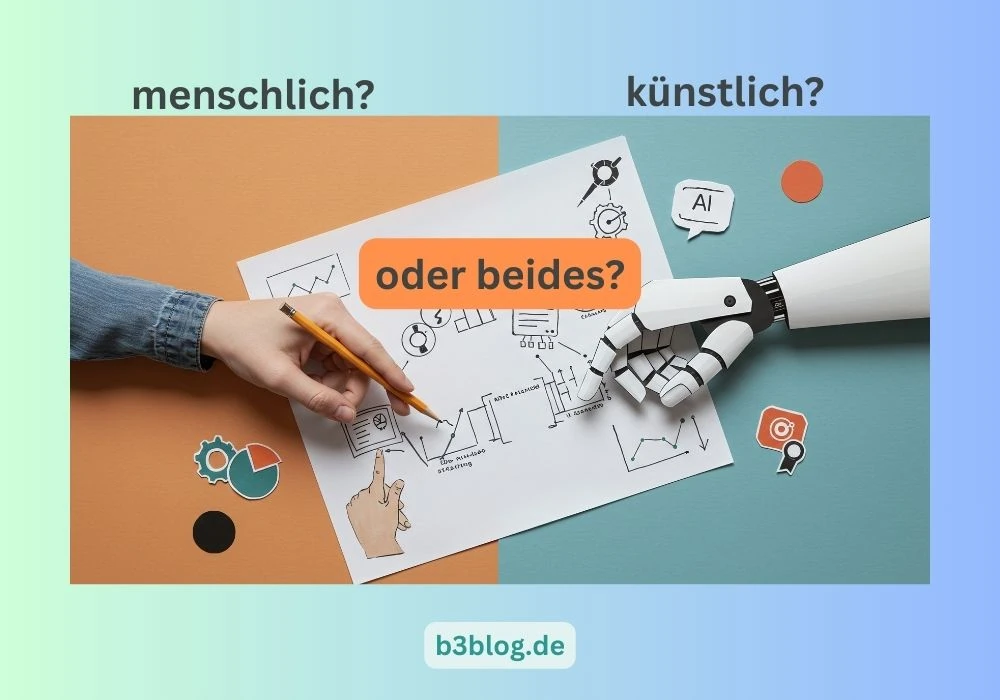
What catches my eye is the accompanying text to the article image. The AI suggests a traffic light system (similar to the food traffic light system) to indicate the proportion of artificial intelligence in texts. There are already several seals for labeling “human intelligence.” They are intended to confirm that a creative work is based purely on human effort. One example is the seal of the American Authors Guild. This seal and others like it award a seal of approval to explicit human creativity.
Seal for human intelligence
In German-speaking countries, there is the MI seal, created by three copywriters, but not limited to text-based professions. The “MI Menschliche Intelligenz” initiative is currently being converted into an association. The MI seal code of conduct lists codes of conduct for ten creative industries that can benefit from the seal. The basic principle applies to every industry: “Human intelligence is irreplaceable. Because only humans can take responsibility for the quality of the work results.” Artificial intelligence is therefore not fundamentally rejected or demonized, but the human contribution is crucial. Or as it says on their About page: “Whether with AI, without AI, or with a little AI, whether alone or in a team: in the end, what counts is that someone with expertise and experience is responsible for the result of the work.” The seal may be used by anyone who pays a certain annual fee for it.
The intention is understandable and honorable, but is a seal really necessary? While some find seals of approval reassuring, others consider them superfluous. The arguments for and against may differ in detail from those for the organic seal, but there are also plenty of controversial views on seals for creative professions – from creatives themselves, from artists, from authors and copywriters, and from designers.
What artificial intelligence has to say about it
Given the rapid pace of developments in the field of AI, I myself have more questions than answers. In order to better structure the many different attitudes, I consulted an AI (!), namely the European LLM Le Chat from Mistral. My specification was: “The focus should be on the different views of people in creative professions on AI, i.e. 1. those who fundamentally reject AI, 2. those who rely on AI without hesitation, and 3. those who see AI as a useful tool that can support their creative work but cannot replace it.”
And here is the result that Le Chat produced:
--- Le Chat, beginning ---
- 1.The AI skeptics: “Algorithms destroy the soul of art”
• Authenticity vs. simulation: AI-generated works are “hollow copies” without genuine emotion or intention. A painter from Berlin: “An algorithm cannot pack life experience into a picture. The MI seal is my promise of quality to customers.”
• Loss of value of creative work: The concern that AI will drive down prices for creative services—and that the MI seal will be the only distinguishing feature left.
• Ethical concerns: Data protection, copyright, and the question of who benefits from AI training (mostly tech companies, not artists).
Criticism of the MI seal:
• Some see it as a “stopgap solution” that does not solve the real problem (lack of regulation of AI).
• Others fear stigmatization: “Those who don't have the seal are quickly labeled ‘AI fraudsters’ – even if only 5% of the work has been optimized with AI.”
Quote: “The seal is like an organic label for art. But who decides what is ‘organic’? And who controls it?” — Lena T., illustrator
- 2.AI enthusiasts: “Those who don't use the tools will be left behind.”
• Efficiency and new opportunities: AI as a “creative turbocharger” – e.g., for brainstorming, layout designs, or overcoming creative blocks. A copywriter: “I use AI like a pencil: it helps me reach my goal faster – but the idea comes from me.”
• Democratization of creativity: AI enables people without formal training to implement creative projects.
• Market opportunities: Those who ignore AI miss out on potential orders – especially in areas such as gaming, advertising, or social media.
Attitude toward the AI seal:
• Rejection as an “artificial barrier”: “Whether a work is good should be decided by the viewer – not a seal.”
• Ironic counter-question: “Should we soon be writing ‘MI-certified’ emails too?”
Quote: “The fear of AI is like the fear of the camera in the 19th century. In the end, those who use it wisely will win.” — Tom R., game designer
- 3.The pragmatists: “AI is a tool – nothing more”
• Hybrid working method: AI as an “assistant” that takes over repetitive tasks (e.g., image editing, spell checking), while humans retain creative control.
• Transparency instead of bans: Instead of demonizing AI, clear labeling is needed – similar to retouching in photography.
• Focus on the process: A novel written with the help of AI is no less “human” if the author makes the final decision.
Position on the AI seal:
• Ambivalent: “A seal can be useful—but only if it doesn't become a moral cudgel.”
• Suggestion: Instead of “MI” vs. “AI,” the focus should be on the proportion of human work (e.g., “80% MI, 20% AI support”).
Quote: “I use AI like a blender in the kitchen: it saves me time, but the recipe comes from me.” — Sophie L., author
--- Le Chat, end ---
Individual processes
Sophie's “quote” is probably what my approach to AI is heading towards (even though I don't like cooking!). As is so often the case, one does not exclude the other, and the solution lies somewhere in the middle. In the case of AI, a healthy dose of skepticism on the one hand and a good dose of curiosity about possible ways to make work easier on the other are appropriate, but where a standard will settle is still open. Large book publishers, which some see as guardians of human creativity, are currently undergoing such processes. Even if books are (still) written by humans, AI is already helping in the background to handle all the processes that can be performed more efficiently with AI tools. The latter cannot replace my work as an editor and author.
None of this answers the initial question of whether a seal for human intelligence is useful or even necessary. What do you think?